


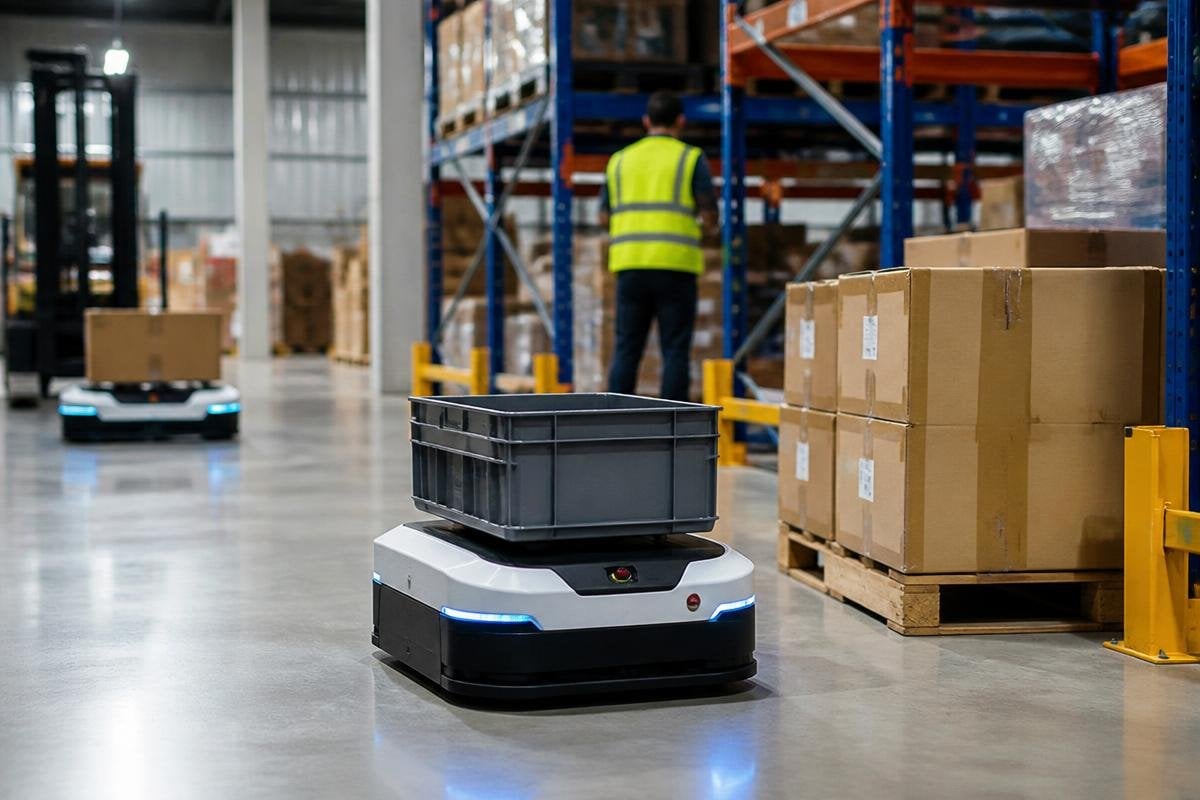
A supply chain can lose hours when one task stops, one route changes, or too few people are available for a shift. Robots can help by moving goods, checking stock, and taking on repeat work while people handle the jobs that need judgment.
- Mobile robots can move bins and pallets between work areas.
- Vision systems can check goods without opening every package.
- Robot data can show where delays start and how often they return.
Where robots help first
The clearest use is the movement of goods inside a warehouse or factory. An autonomous mobile robot, or AMR, uses sensors and software to travel between set points without a fixed rail. It can carry a tote, bring parts to a work cell, or take finished goods to storage.
That matters when a facility must change its layout or handle a new product mix. A fixed conveyor needs a planned route and physical changes when that route shifts. An AMR can receive a new destination in software, though the site still needs safe paths, clear rules, and staff who can manage exceptions.
Robotic arms help at the next point in the process. A vision system uses cameras to inspect an item or locate its position, then the arm can pick, place, sort, or pack it. These tasks suit robots when the work repeats and the objects arrive in a known range of shapes and sizes.
Data can show the weak points
A robot also records useful operating data. Its system can log travel time, stopped jobs, battery state, task queues, and blocked routes. That record can show where work waits before a delay reaches the shipping dock.
The value comes from the link between the data and a decision. If robots stop near one aisle, the site can check that aisle’s layout, traffic rules, or stock position. If a packing arm rejects one type of item more often, staff can inspect the gripper, lighting, or item packaging.
A dashboard can show where a robot stopped, but it can’t tell you whether the failure came from the load, route, or software. Robot24.com robotics coverage can tie that event to a named machine, test site, date, and result before the article examines where resilience stops.
Resilience has limits
Robots don’t remove supply chain risk. They can keep an internal task running, but they still depend on power, software, spare parts, network access, and people who can fix faults.
A robot fleet can also spread one software error across many machines if the same update reaches all of them. The work itself matters, too: robots handle repeatable routes and tasks better than open-ended work with changing objects.
A warehouse that stores many shapes, fragile items, or goods with poor labels may need more human checks and a slower rollout.
Cost adds another limit. The purchase price is only one part of the decision. You also need charging equipment, floor changes, safety checks, software support, training, and repairs. I’d start with one narrow task where the delay and labor cost are already clear.
A practical decision check
Before choosing a robot, check the job rather than the product brochure.
- Map the task: record the handoffs, travel paths, wait points, and human checks.
- Measure the baseline: note task time, error rate, missed orders, and stoppages.
- Set the boundary: decide which cases the robot handles and which cases go to a person.
- Plan the failure state: name the safe action for a blocked route, empty battery, bad grasp, or lost network.
- Keep a manual path: make sure staff can continue the work during repair or software downtime.
- Review the record: compare output, faults, and labor use after the trial, then decide whether to add more robots.
What to do next
A small pilot can answer the questions that a sales demo cannot. Pick a repeatable task, record its starting performance, and set a clear point at which the robot must stop or hand work back to a person.
That process makes resilience measurable. You can see whether the robot keeps goods moving during a delay, or whether it adds another system for staff to manage. The next useful proof is not a smoother demo; it is a site record showing fewer stopped tasks over a defined period.