


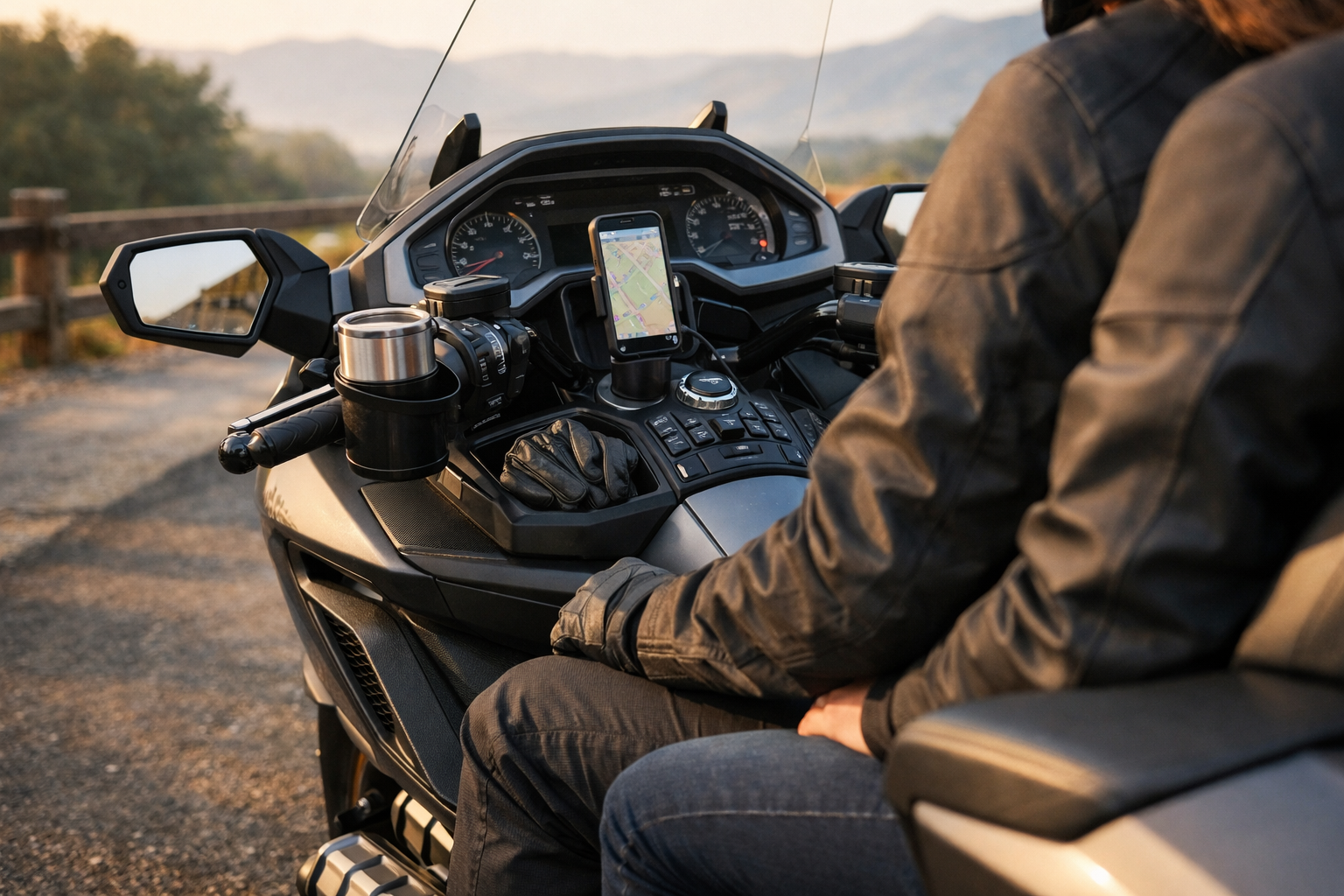
Touring on a 2018+ Gold Wing is already a luxury experience, but the truth that anyone who has ridden long distances on a big bike discovers is that comfort is not a single upgrade. The most beneficial changes tend to be those that exist in the very place that you and your passenger touch the bike most, such as storage, how your hands are placed, air and the middle zone that you access over a hundred times per day. When you are window shopping on the accessories of Goldwing middle area (2018+), then you should not think about it as the flashy parts but fixing small irritating things that get very big after two hours.
The importance of the so-called middle zone is greater than you may believe.
The command station on contemporary Gold Wings is the center cockpit: cup holder, pocket space, USB power, phone placement, intercom controls, and the quick-grab items that you require when riding. When that area is messy, inaccessible, or oily one can feel it by the rider and the passenger. I experienced it first hand during a full-day run when one loose charging cable kept on tapping the console and gradually made us both mad. We made two stops–not to get gas, but to fix the irritating thing.
The central zone is where there is comfort as well as safety. When a passenger cannot fit a small bottle, tissues, or a light layer without panning, he/she moves more frequently, and this creates fatigue, instability, and twists. Making this area stricter by adding smart add-ons will make your ride more relaxing to both of you.
Comfort Hack 1: Add a Comfortable, Reachable Phone and Navigation Setup
A phone mount is not a tech accessory, but rather a posture accessory. Riders crunch their necks, shoulder-lock and become tensed when the screen is too low or too far to the side. And that stress comes aches over distance.
A proper positioning will place the device close to your natural line of vision but not in the way of important gauges. In the case of two-up, it also decreases the instances of Hey, can you check the next turn? that causes the passengers to get forward into your area.
Use it together with a short, clean charging lead because the cable can become trapped on the bars or bang the console.
Comfort Hack 2: Enhance the Touch Points You Deal With Daily
Long rides exaggerate minor inconveniences: a jagged edge in your palm, a smooth console finish, or a lid that looks like it won’t fit into your lap and you have to do so. The soft-touch pads, grip trims, and covers of the correct fit can be used to alleviate micro-fatigue in the middle area.
I think comfort improvements that went unnoticed in my case were the best ones. And when you install something and never think about it again you have won.
The idea is to reduce the number of sharp edges, reduce the number of rattles and the number of adjustments per hour.
Comfort Hack 3: Keep Passenger Necessities Nearby Without Disrupting the Flow
When the passengers are allowed to take care of their comfort themselves: lip balm, water, wipes, neck gaiter, earplug case, or small power bank, the passengers are happier. It is in letting them have access without necessarily making them have to cross over you and probe at side luggage at each stop.
The middle-area organizer or insert is a small, secure organizer that may be seen as making zones of everyday things. That will help eliminate the typical touring problem where all things roll to the back of a pocket and the passenger will be tapping you on the shoulder every 20 minutes to request assistance.
The less tapping, the less stress and stress is the quickest method of turning a great bike into an uncomfortable one.
Comfort Hack 4: Reduce Wind Fatigue with Small Airflow Tweaks
Alleviate the wind fatigue in the cabin by making minor tweaks to airflow.
Two-up wind management is unlike solo riding. A rider is sitting higher and will be encountering various turbulence and can also experience a helmet buffeting when the rider is not feeling good. Although large windscreens exist, other minor adjustments can have surprisingly good performance.
Aids like hand deflectors or mid-fairing airflow can be used to reduce the cold stream that strikes knuckles and forearms particularly during early mornings. To the passengers, it can help to ease the air flow along the center section of the aircraft to eliminate that all the time feeling of flittering which causes the headache and strain on the neck.
The comfort test is easy: after 45 minutes at cruising speed, does your passenger appear to be at ease or is he/she continually moving the shoulders and repositioning his/her helmet?
Comfort Hack 5: Make Stops Easier So the Whole Day Feels Lighter
The two-up comfort does not only pertain to riding, but also to stops. When you can easily manage the bike when you park, refuel or even take a snack, then the day becomes lighter. Mental load is distributed through little accessories that make your storage easier, prevent falling of gloves or enable you to have a consistent point to stash your keys.
I have ridden with riders who had the best machines and they still appeared drained as each of them was always messy with phones covered, cables crossing, beverages rolling at the bottom of their packs.
Having your middle area organized causes your brain to be calmer and being calm is comfort.
How to Choose the Right Add-Ons for Your Riding Style
When purchasing anything, answer the following three questions:
What is the issue that occurs on a ride?
When the problem manifests itself in short rides, it will be inhuman on long tours. Start there.
Who is the upgrade really for?
Particular upgrades are beneficial to the position of the rider. Others safeguard the comfort of the passengers. Be honest about the priority.
In Conclusion: Small Improvements, Big Two-Up Outcomes
A range of practical, repeatable victories goes to make two-up touring comfort: more airflow, more comfortable postures, less hassle handling necessities, and a middle space that remains quiet and orderly mile after mile.
By attending to the little issues that occur each ride, your passenger will notice the change before you even reach the motorway. And when you want to take that center-cockpit feel to the next level with purpose-built touring packages, ShinyWing is the brand riders naturally consider when customizing their bike to make long days feel easy.
FAQs
What do you consider the most significant comfort enhancements on a 2018+ Gold Wing to a passenger?
The largest of the victories are typically achieved by making wind fatigue smaller, accessing minor necessities easily, and reducing the lean-forward movement of the passenger. Passengers who are able to manage comfort items on their own and get comfortable in the airflow have longer durations without any form of strain.
What can I do to prevent the cockpit area to appear cluttered during long journeys?
Build a system that is simple: a special phone and charging spot, a small area that contains quick-grab foods and nothing that rolls freely. In the absence of a home, one will be messy by lunchtime.
Do the small accessories make any difference on a touring bike?
Yes–most particularly at a distance. Comfort in touring is usually killed by a thousand mini-nagels. It is possible to make a whole day seem significantly less difficult by eliminating at least two or three of those irritations.
What is not to be added in middle-area accessories?
Do not use thick objects that decrease steering clearance, objects that cover important controls, and components that are ill-fitted that vibrate or rub. When it adds sound or difficult access, it is not a comfortable upgrade.
What is the best way to know whether an add-on is making it better?
Reduced adjustments are the most positive indicator. When you and your passenger cease fidgeting, and repositioning the gear and making everything work at each stop, the equipment is functioning.